
Last Updated: November 6, 2026
Quick Summary
The best spiritual wall art for a sanctuary has one clear focal subject, a restrained palette, and craftsmanship that rewards close looking. Praneer's framed collection offers deity imagery finished with 24k gold leaf or fine gold detailing, often set against red velvet backgrounds. Choose the subject to match the room's purpose, and hang the piece with the center around 57 to 60 inches from the floor.
- Choose one central figure or symbol so the piece draws the eye and supports stillness.
- Hang the center of the artwork about 57 to 60 inches from the floor, roughly eye level.
- For a seated prayer corner, drop the center to about 48 to 54 inches.
- Use warm lamplight around 2700K to 3000K, placed to the side at 30 to 45 degrees.
Table of Contents
- What Makes Wall Art Suitable for a Spiritual Sanctuary
- Choosing Deity Wall Art: Lakshmi, Ganesha and Other Subjects
- Spiritual Wall Art for Living Room Sanctuaries
- Spiritual Wall Decor for Bedroom Meditation Spaces
- Placing, Sizing and Lighting Your Sanctuary Piece
- Booking a Consultation to Choose Your Sanctuary Piece
- Frequently Asked Questions
What Makes Wall Art Suitable for a Spiritual Sanctuary
A spiritual sanctuary needs spiritual wall art that invites calm rather than competes for attention. The best pieces for a dedicated space share a few traits: a focal subject, a restrained color palette, and craftsmanship that rewards close looking. Praneer's framed collection features deity imagery finished with 24k gold leaf or fine gold (99.9) detailing, often set against red velvet backgrounds.
Many buyers start by asking whether the piece will feel devotional or decorative. The answer depends on the subject, the frame, and where it hangs. A carefully chosen framed piece can anchor a prayer corner without turning the room into a showroom.
Several qualities separate a sanctuary piece from ordinary wall decor:
- A clear focal point: One central figure or symbol draws the eye and supports stillness.
- Warm, reflective materials: Gold leaf catches lamplight and changes subtly through the day.
- Proportion to the wall: A piece should fill its space without crowding nearby objects.
- Visual quiet: Busy patterns can pull attention away from meditation or prayer.
Explore the framed art collection to compare subjects and finishes before narrowing your choice.
Choosing Deity Wall Art: Lakshmi, Ganesha and Other Subjects
The subject you choose shapes the mood of the room, and in many traditions the imagery carries specific meaning. Understanding that meaning helps you place a piece with care rather than treating sacred figures as generic decor.
Lakshmi. Associated with prosperity, abundance, and household well-being. She is commonly placed near entryways, living areas, and cash boxes in South Asian homes. A gold-leaf Lakshmi piece suits a space meant to welcome and to bless.
Ganesha. Known as the remover of obstacles and the patron of beginnings. He is often placed near doorways, study corners, and workspaces. A relief-style Ganesha frame brings sculptural depth and works well where it can be seen up close.
Krishna. Associated with devotion, music, and guidance. A smaller Krishna piece suits a bedroom meditation corner or a personal altar where intimacy matters more than scale.
Durga. A symbol of strength and protection. A larger Durga piece can anchor a shared living space without overwhelming it.
Buddha and Buddhist-inspired imagery. Buddha figures and lotus motifs are widely used in meditation spaces across traditions. A common pattern is to keep the presentation simple, a single seated figure, a lotus, or a minimal silhouette, so the image supports stillness rather than becoming a display object.
Sacred geometry and symbols. Mandalas, the hamsa, the evil eye, and yantra designs appear across multiple traditions. Their meanings vary by culture, so it is worth knowing the origin of a symbol before hanging it in a place of prayer.
Respectful representation across traditions. If your sanctuary is interfaith or you are drawing on a tradition that is not your own, a few habits help. Learn what the figure or symbol means before you buy. Avoid mixing symbols from different traditions in a single arrangement unless you understand how they relate.
Practical selection points:
- Match the subject to the room's purpose. Daily prayer, reflection, and display call for different figures and scales.
- Check the level of ornament. Highly detailed pieces work best where they can be seen up close; simpler pieces suit distant walls.
- Plan around existing decor. Gold tones pair well with warm woods, brass, and cream textiles; cooler palettes suit silver and stone finishes.
- Consider the frame as part of the meaning. A velvet backing and gold leaf read as devotional; a plain wood frame reads as neutral decor.
A common mistake is choosing a piece only from a product photo, since finishes can read differently in person than on a screen. Consider the finish and scale before ordering, and ask about the symbolism if you are unsure.
Spiritual Wall Art for Living Room Sanctuaries
A living room sanctuary has to work for guests, family, and quiet moments alike. Place a framed deity piece where it can be seen from the seating area, typically at eye level above a console or sideboard. Pair it with a small lamp so the gold detailing catches light in the evening.
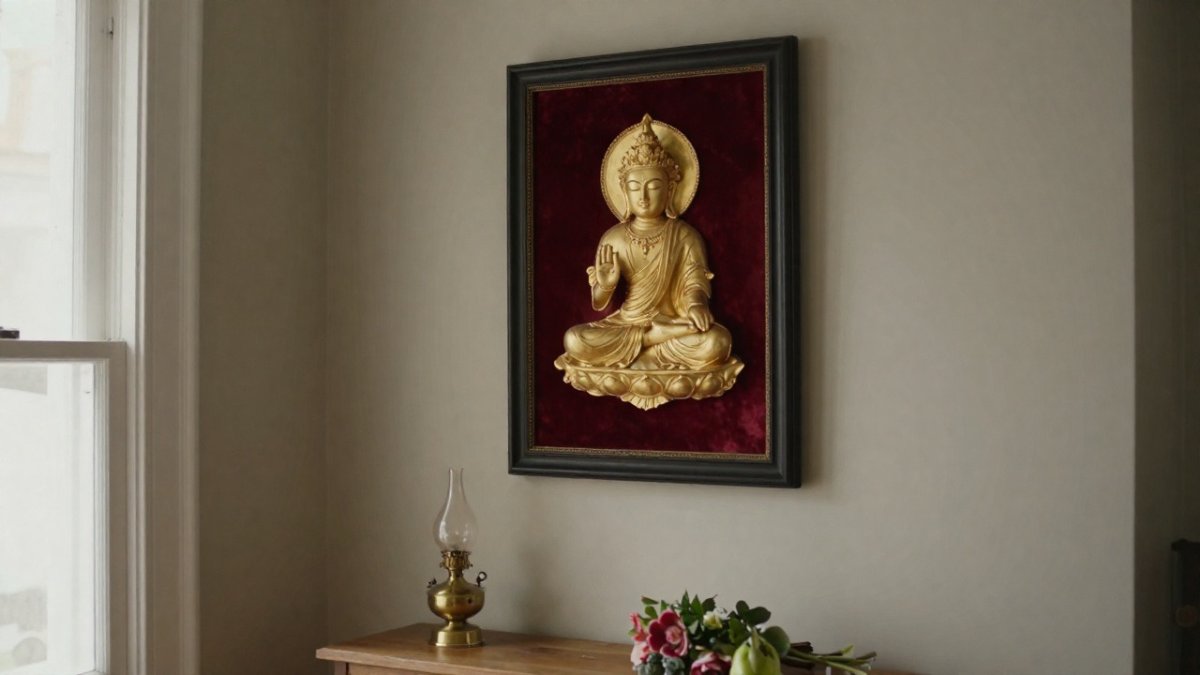
For a shared space, a Durga framed piece with 24k fine gold foil offers a strong presence without overwhelming the room. Choose a size that suits the wall, and avoid hanging it where it competes with a television or large window.
!Framed gold-leaf deity wall piece above a wooden console with a brass oil lamp in a living room corner
Spiritual Wall Decor for Bedroom Meditation Spaces
Bedrooms call for a softer approach. Smaller framed pieces tend to suit a meditation corner better than oversized canvases, because they feel personal rather than dominant. A Krishna framed piece in 24k fine gold can sit comfortably above a cushion or small altar without dominating the room.
Lighting matters more in a bedroom than in a living room. Warm, indirect light brings out gold detailing, while harsh overhead light can flatten it. Position a lamp to the side rather than directly above the piece.
Placing, Sizing and Lighting Your Sanctuary Piece
Placement shapes how a sanctuary piece reads. A piece hung at the wrong height or washed out by a window can read as decoration rather than devotion.
Hanging height. The standard museum convention is to hang the center of the artwork at about 57 to 60 inches from the floor, roughly eye level for an average adult.
Scale and proportion. A common rule of thumb is that artwork should span about two-thirds to three-quarters of the width of the furniture beneath it. On a bare wall with no furniture anchor, aim for a piece that covers roughly 60 to 75 percent of the available wall width in that zone; anything smaller floats, anything larger crowds.
Focal point and visual balance. A sanctuary should have one dominant focal point, not three. If the room already has a fireplace, a large window, or a television, hang the artwork on an adjacent wall so it does not compete.
Lighting. Gold leaf and metallic finishes change through the day. Natural daylight reveals the finest relief detail, while a warm lamp (around 2700K to 3000K) creates an evening glow. Place the light source to the side at roughly 30 to 45 degrees rather than directly overhead, which flattens relief.
Glare and fading. Glass and acrylic glazing can throw glare from windows and lamps; matte finishes and anti-reflective glazing reduce it. Keep pieces out of direct sun, since prolonged UV exposure fades both frames and fabric backings. If a window is unavoidable, sheer curtains or UV-filtering film help.
Watch out: hanging a piece above a heat source, a radiator, fireplace mantel, or heating vent, can warp the frame and dry out velvet or fabric backing over time.
Before you commit, mark the dimensions on the wall with painter's tape and stand back at seated and standing eye level. Most buyers find the taped outline settles the size question faster than any product photo.
The article's placement guidance comes down to a few measurable targets:
| Factor | Guideline | Note |
|---|---|---|
| Hanging height (standard) | 57 to 60 inches | Center of the artwork, roughly eye level |
| Hanging height (seated prayer corner) | 48 to 54 inches | Center of the artwork, meets gaze while seated |
| Clearance above furniture | 6 to 8 inches | Gap between furniture top and bottom of frame |
| Width relative to furniture | About two-thirds to three-quarters | Artwork width under a console or sideboard |
| Light color temperature | Around 2700K to 3000K | Warm evening glow for gold detailing |
| Light angle | 30 to 45 degrees | Side lighting rather than directly overhead |
| Multi-piece spacing | 2 to 3 inches | Gap between frames in a grouped set |
Booking a Consultation to Choose Your Sanctuary Piece
Choosing the right piece for a dedicated space can take time, especially when subject, size, and lighting all matter. If you want guidance, contact the Praneer team to talk through your room and options.
Frequently Asked Questions
What are some good spiritual wall decor options?
Framed deity portraits, gold-leaf devotional prints, and symbol-based pieces such as lotus or Om designs are common choices. Praneer's collection centers on framed deity art of Goddess Lakshmi and Lord Ganesha, with 24k gold leaf or fine gold (99.9) detailing, often set against red velvet backgrounds. Pricing depends on the piece, frame size and options, so check Praneer's website for current prices. Choose the subject that matches your practice first, then the finish and size that suit the room.
What spiritual wall art works best in a living room?
Living rooms get more traffic and light, so a piece with a strong central figure and a framed finish holds up well there. Larger framed pieces hung at eye level anchor a seating area, while smaller pieces work in a gallery grouping. Gold detailing reads well under warm lamp light, which helps the artwork stand out in the evening. Keep the frame and background tones consistent with the room's existing palette so the piece feels intentional rather than added on.
Where should I hang spiritual wall art in a bedroom or meditation space?
In a bedroom or meditation space, hang the piece where it is visible when you sit or lie down, typically at eye level when seated. Avoid placing it directly above a bed headboard where it can feel crowded, and leave clear space around it. Soft, indirect lighting protects the finish and creates a calmer atmosphere. A single focal piece usually suits a quiet room better than several competing pieces.
Is 24k gold leaf worth paying more for than a printed deity frame?
Gold leaf reflects light differently from printed metallic ink, which can add visible depth and texture in close view and changing light. Whether it suits you depends on whether you want a devotional centerpiece or a simpler, printed image for daily display.
