
Last Updated: November 6, 2026
Quick Summary
Luxury wall art for Indian homes is framed, handcrafted artwork that combines traditional motifs, sacred imagery, and premium materials to turn a plain wall into a focal point. Praneer's collection features 24k gold leaf or fine gold (99.9) detailing, often set against velvet. Choose pieces by room, style, and budget so the artwork anchors the space rather than filling it.
- Center artwork at eye level, about 57-60 inches from the floor to the middle of the frame.
- Leave 6-10 inches between the top of the sofa and the bottom of the frame.
- Tanjore work, with gesso relief and gold foil, suits puja rooms and formal living rooms.
- Ask sellers which region and tradition a piece comes from and whether the artist is named.
- Keep framed pieces out of direct sunlight and dust them with a dry cloth.
Table of Contents
- Why Luxury Wall Art Belongs in Every Indian Home
- Large Indian Wall Art for Living Room: Sizing and Placement
- Traditional Indian Wall Decor: Styles That Endure
- Handcrafted Indian Wall Art: What Your Money Actually Buys
- Buying Indian Wall Art Online: A Practical Checklist
- Choosing Your Praneer Piece for the Room It Will Live In
- Frequently Asked Questions
Why Luxury Wall Art Belongs in Every Indian Home
Luxury wall art for Indian homes is framed, handcrafted artwork that combines traditional motifs, sacred imagery, and premium materials to turn a plain wall into a focal point. Praneer's collection features 24k gold leaf or fine gold (99.9) detailing, often set against velvet.
That is the case for investing in luxury wall art rather than filling space with mass-produced prints. The Smithsonian's guide to caring for works on paper and framed art makes the point well: framed art is a long-term object, not a seasonal purchase.
Below, we break down seven pieces by room, style, and budget so you can choose with confidence.
Large Indian Wall Art for Living Room: Sizing and Placement
A general guideline for large Indian wall art in a living room is to size it in proportion to the furniture beneath it, so the piece feels anchored rather than undersized.
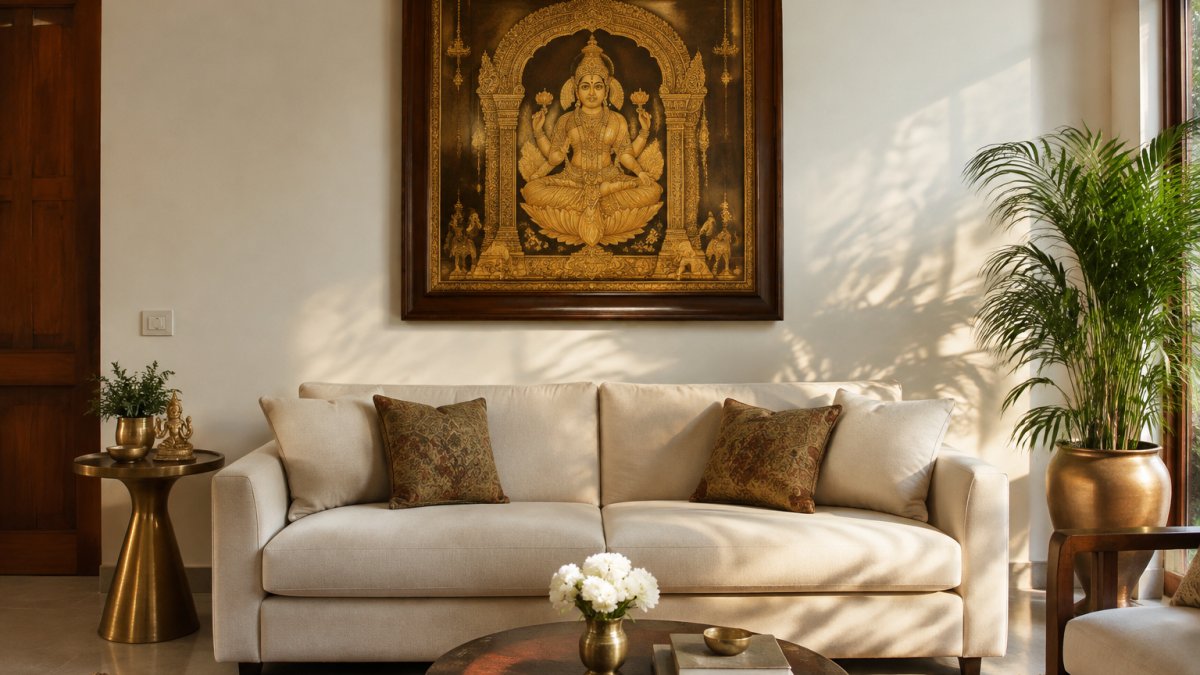
Hanging Height and Layout Rules
Center the artwork at eye level, about 57-60 inches from the floor to the middle of the frame. Over furniture, leave 6-10 inches between the top of the sofa and the bottom of the frame. For a gallery wall, keep 2-3 inches between frames and treat the whole cluster as one shape.
- Single statement piece: center it over the sofa
- Pair of panels: align tops, space 2-4 inches apart
- Gallery wall: start from the center frame and build outward
Traditional Indian Wall Decor: Styles That Endure
Traditional Indian wall decor covers a family of styles, each with its own visual signature, regional origin, and ideal setting. Knowing which style suits which room, and how to frame and light it, is what separates a considered luxury purchase from a decorative impulse buy.
| Style | Regional Origin | Signature Look | Best Room | Palette and Frame |
|---|---|---|---|---|
| Pichwai | Rajasthan (Nathdwara) | Krishna scenes, lotus motifs, rich pigment on cloth | Living room, entryway | Deep indigo, emerald, and gold; dark wood or antique gold frame |
| Madhubani | Mithila region (Bihar) | Fine double-line work, folk figures, natural dyes | Hallway, study | Earth tones and black line work; slim natural wood frame |
| Pattachitra | Odisha | Mythological narrative, bold outlines on cloth or palm leaf | Dining room | Warm ochre, red, and cream; carved teak frame |
| Gond painting | Central India (Madhya Pradesh) | Dot-and-line animal and nature forms | Modern living space | Bright mineral colors on neutral ground; float frame |
| Lippan art | Kutch (Gujarat) | Mirror work and clay relief | Accent wall, puja room | White clay with mirror; unframed panel or shadow box |
| Tanjore | Tamil Nadu | Gesso relief, gold foil, glass beads | Puja room, formal living room | Gold-dominant with red and green; ornate gilded frame |
Pichwai, Madhubani, and Beyond
Pichwai paintings began as temple hangings behind Krishna shrines, and their dense lotus and cow motifs still read as devotional. Madhubani, from the Mithila region, uses double-line borders and packed pattern.
Tanjore work is the style most associated with luxury in South Indian homes. Its gesso relief and gold foil give the surface real dimension, and a single Tanjore Krishna or Ganesha panel can anchor a puja room or formal living wall without any supporting pieces. Gond painting, by contrast, is the easiest traditional style to place in a contemporary or minimalist interior because its dot-and-line forms read as graphic art rather than devotional iconography.
Matching Style to Room and Interior
A common pattern in luxury homes is to let the room's function set the style. Entryways carry a single Pichwai or Pattachitra panel that sets a cultural tone the moment a guest arrives.
Color coordination follows the same logic. In a contemporary or minimalist room with a neutral palette, a single saturated traditional piece becomes the focal point and should be framed in black, natural wood, or brushed brass.
Watch out: mixing more than two traditional styles on one wall usually reads as a collection rather than a composition; pick one style as the anchor and let the others support it at smaller scale.
Handcrafted Indian Wall Art: What Your Money Actually Buys
Handcrafted Indian wall art differs from printed decor in materials, hand-finishing, and traceability of origin.
Materials and Hand-Finishing
- Gold leaf vs. gold ink: real 24k leaf catches light at an angle and shows subtle variation across the surface; metallic ink looks flat and uniform under the same light
- Frame construction: solid wood with proper joinery and glazing versus thin composite that warps over time
- Backing material: velvet backgrounds add depth that paper cannot, but velvet also demands careful handling and storage
- Finishing: hand-applied detail, brushwork, gesso relief, foil application, versus machine reproduction that repeats identically
A useful test is to ask for a close-up of the gold detailing and the frame corner. Hand-applied leaf shows tiny overlaps and irregular edges; printed metallic finish is perfectly even. Neither photo alone proves quality, but together they reveal whether a piece was made by hand or reproduced.
Provenance and Artist Attribution
Provenance is the documented origin of a piece, the region, the workshop or artist, and the tradition it comes from. In luxury buying, provenance is what justifies a premium beyond materials.
Ask three questions before you buy: Which region and tradition does this piece come from? Who made it, and is the artist or workshop named? Is there any documentation, a certificate, a maker's mark, or a signed card, that travels with the piece? A seller should be able to answer all three clearly.
Responsible Sourcing and Artist Context
Responsible sourcing means the artisan was paid fairly and the materials were obtained legitimately. Most buyers never ask, which is why the gap persists.
Artist context also affects the object's long-term value. Folk traditions like Madhubani and Gond are living practices, and a piece that credits its maker connects the buyer to that lineage. When a seller cannot name the artist, treat the piece as decor rather than collectible art, and price your expectations accordingly.
Watch out: a certificate of authenticity is only as good as the seller issuing it, ask what specifically it documents (materials, artist, region) rather than accepting the paper at face value.
Buying Indian Wall Art Online: A Practical Checklist
Buying Indian wall art online comes down to verifying four things before checkout: materials, dimensions, shipping protection, and returns. Run this checklist:
- Confirm the exact gold specification, 24k leaf or fine gold (99.9)
- Check the framed dimensions, not just the artwork size
- Ask for real customer photos of the piece installed
- Confirm the packaging is rigid and corner-protected
- Read the return window and who pays return shipping
- Confirm the velvet or backing material and its care needs
Care, Shipping, and Returns
Keep framed pieces out of direct sunlight to protect both pigment and velvet. Dust with a dry cloth.
Ask about the return policy before you buy, since returns for large framed pieces can be costly.
Choosing Your Praneer Piece for the Room It Will Live In
Match the piece to the room before you match it to a trend. A small puja room suits a single ornate Lakshmi or Ganesha panel, not a crowded gallery. A minimalist office can carry one gold-leaf deity piece if the frame is restrained and the wall is otherwise clear.
Praneer's collection includes framed pieces with 24k gold leaf craftsmanship or fine gold (99.9) detailing, with elegant velvet background options. For a housewarming or festival gift, pricing and packaging details are best confirmed on the Praneer website.
Best for: collectors and devotees who want sacred artistry with real gold detail. Skip if: you want a casual, low-cost print.
Frequently Asked Questions
Where should I hang deity wall art at home?
Place deity artwork in a puja room facing east or north when possible, or in a living room or entryway where it can be seen and respected. Hang it at eye level, roughly 57 to 60 inches from the floor to the center of the frame, and avoid spots near bathrooms or below heavy shelving. In a small puja space, a single ornate gold-leaf piece on a plain wall reads as a focal point rather than feeling crowded.
What colors work well with traditional Indian wall decor?
Warm neutrals like cream, sand, and soft ivory let gold leaf and red velvet stand out without competing. Deep greens, terracotta, and muted blues also pair well with traditional Indian art and carved wood. If your room is already colorful, keep the wall behind the artwork plain so the piece carries the visual weight. In minimalist offices, a single gold-leaf piece against white or greige walls adds warmth without clashing.
Is handcrafted Indian wall art worth the investment?
Handcrafted pieces made with 24k gold leaf or fine gold detailing differ visually from printed reproductions. The value comes from the labor, the materials, and the design detail you can see up close. Ask the seller for close-up photos and real customer images before buying, and confirm the gold specification and frame construction in writing.
How do I care for framed wall art with gold detailing?
Dust gently with a dry cloth and keep the piece out of direct sunlight and humid areas.
The challenge is simple: most walls stay blank because choosing feels risky. Praneer removes that risk with premium framed wall art, 24k gold leaf and fine gold (99.9) detailing, and velvet backgrounds that hold their richness for years. Get started with Praneer and give your home a centerpiece worth building a room around.
